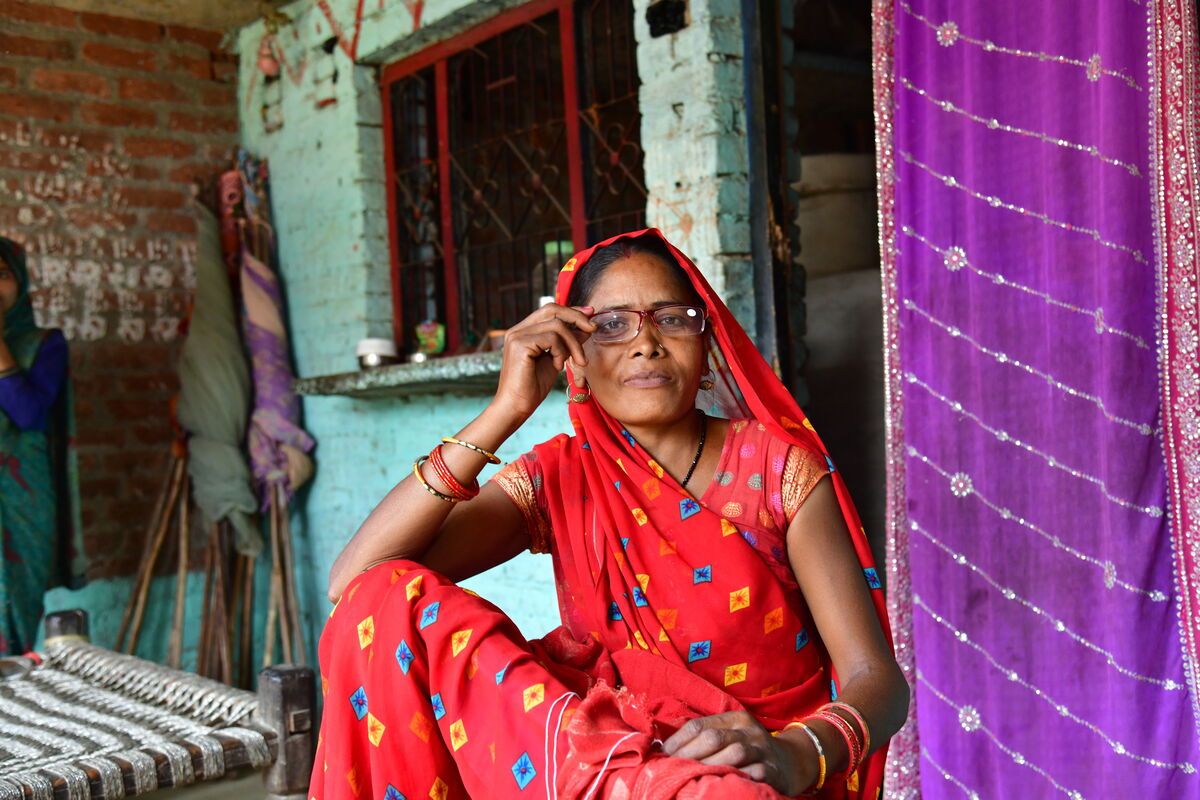
Muneem wearing near vision glasses received as part of a Dr Shroff’s Charity Eye Hospital Peek-powered programme in Mohammadi, India.
Credit: Dr Shroffs Charity Eye Hospital / Peek Vision
Peek’s digital presbyopia calculator could improve access to near vision glasses
A study has found that a new tool developed by Peek and its partners can help trained non-specialists select and dispense ready-made near vision glasses accurately and quickly in communities.
Presbyopia is the age-related loss of near vision that affects almost everyone over 40. Loss of near vision affects everyday activities such as reading or handling money, as well as livelihood-related tasks such as stitching or manufacturing. Worldwide, 826 million people live with uncorrected presbyopia, compromising their independence, quality of life and earning potential.
Ready-made near vision glasses (sometimes called “reading glasses” or “ready readers”) can provide a simple, cost-effective solution to presbyopia for most people. However access is often limited by shortages of specialist eye care workers (such as optometrists), lack of awareness, cost and the need for a separate referral appointment.
Working with our partners Dr. Shroff’s Charity Eye Hospital, Peek has developed a new presbyopia calculator feature, part of the wider Peek eye health platform. It guides users – typically community health workers or other non-specialists – through an easy-to-use workflow to choose the appropriate strength of near vision glasses for people with uncomplicated presbyopia.
The presbyopia calculator is only triggered when distance-vision impairment and other eye health concerns have been ruled out; anyone with suspected additional needs is referred for specialist care.
In the peer-reviewed validation study, published in Frontiers in Ophthalmology, three community health workers in Uttar Pradesh, India, were trained to use the tool. They used it with 378 participants with presbyopia and no other vision impairment or eye health issues. 92.9% of lens powers selected by community health workers matched an optometrist’s prescription exactly, while 99.5% were within ±0.50 dioptres.
Data from eye health programmes using Peek show that 44% of people whose only identified need is near vision glasses do not attend their referral. Providing glasses in the community could remove this barrier and expand access to near-vision correction.
Dr Shalinder Sabherwal, Director of Public Health and Projects at Dr. Shroff’s Charity Eye Hospital and the study’s senior author, says:
“This study shows that trained community-based workers can provide ready-made near vision glasses accurately and quickly with the right digital guidance. That could bring treatment closer to people while freeing up specialists’ time to focus on more complex cases.”
The approach supports wider efforts to expand access to refractive error services. WHO guidance identifies community health workers as appropriate providers of ready-made near-vision glasses, while emphasising the importance of quality standards and referral pathways.
Dr Marzieh Katibeh, Data Analyst and Health Systems Innovation Researcher at Peek Vision, and the study’s lead author, says:
“There is growing international recognition that ready-made near vision glasses can be provided safely in the community. This tool helps turn that ambition into a practical, consistent process, while ensuring that people with more complex needs are still identified and referred.”
The calculator is now being introduced into Peek-powered programmes. Each partner organisation decides if the tool is appropriate for use in their local context. Peek will use early implementation data to understand how it performs in routine services and explore how it can support broader eye care pathways.
The study was funded by the Livelihood Impact Fund Eyeglasses Initiative. This work was also supported by the National Institute for Health Research (NIHR) (using the UK’s Official Development Assistance Funding) and Wellcome Trust under the NIHR-Wellcome Partnership for Global Health Research.
Abigail Steinberg, Executive Director, of Livelihood Impact Fund’s Eyeglasses Initiative, says:
“Expanding access to eye care requires many different approaches and tools. We’re delighted that this new feature on Peek’s platform is one of many approaches that can help pave the way for more screenings, near-vision glasses, and referrals for communities.”